The Cycle of Avoidance in Anxiety: Why What Feels Safe Isn’t Always Helpful
June 4, 2025

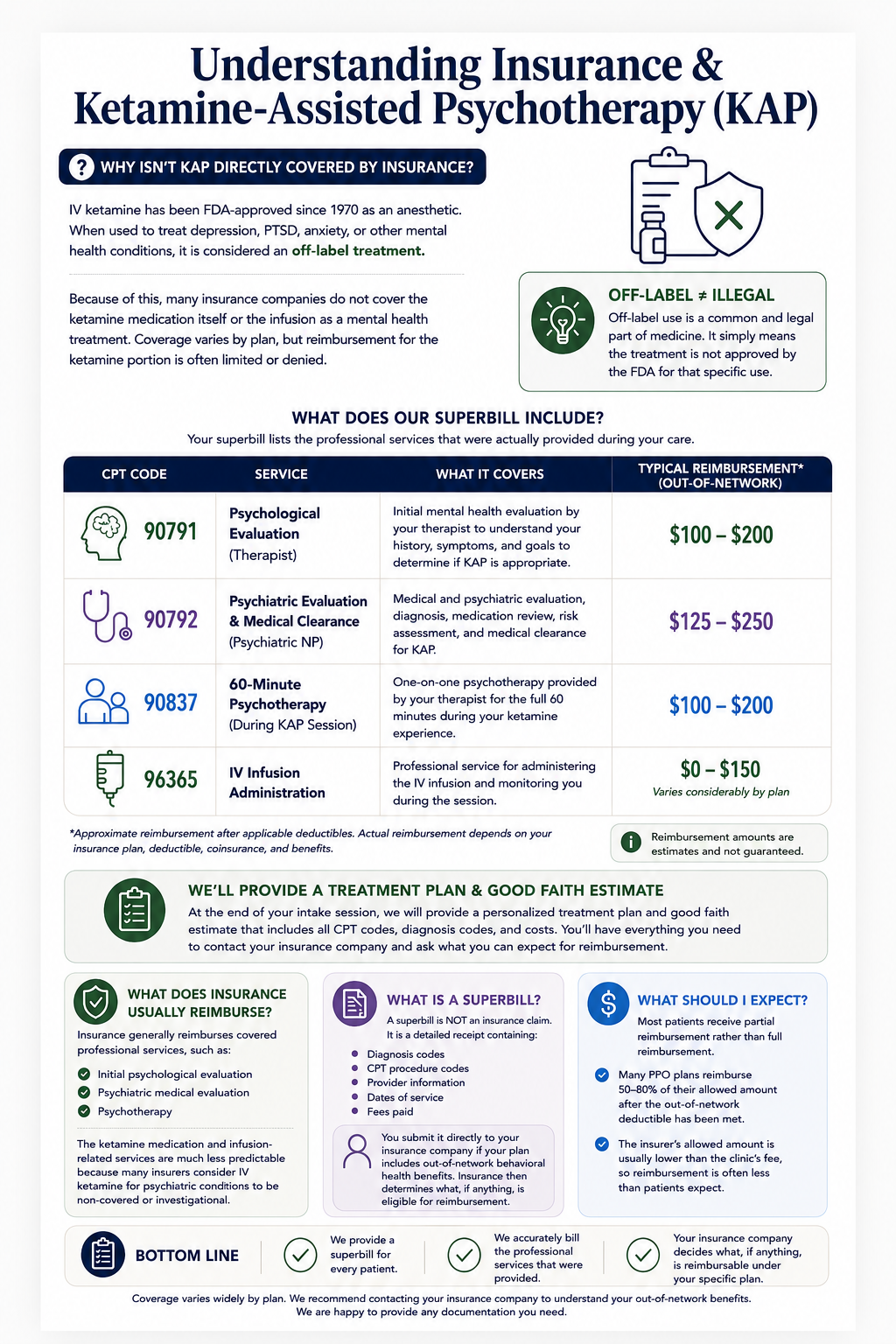
If you've researched ketamine treatment for depression, anxiety, PTSD, or another mental health condition, you've probably run into a confusing mix of messages. Some clinics advertise "insurance accepted" or "$49 with insurance." Others, like ours, are transparent that treatment is out-of-pocket. So which is it — is ketamine covered or not?
The honest, short answer: IV ketamine for mental health is not an FDA-approved treatment, and it is not a covered benefit under virtually any commercial insurance plan, Medicare, or Medicaid. If a clinic is telling you otherwise, it's worth understanding exactly what's being billed, because it's very likely not the IV ketamine infusion itself.
Why Insurance Doesn't Cover IV Ketamine for Mental Health
Ketamine was FDA-approved decades ago as an anesthetic. Using it off-label, delivered by IV, to treat depression, anxiety, or PTSD is well-supported by clinical research, but it has never gone through the FDA approval process for a psychiatric indication. Insurance companies generally only reimburse treatments that are either FDA-approved for the diagnosis being treated, or that have an established, evidence-backed billing pathway for that specific use.
That's different from Spravato (esketamine), a nasal spray version of a ketamine-related compound that is FDA-approved specifically for treatment-resistant depression. Spravato has its own drug code, its own REMS (Risk Evaluation and Mitigation Strategy) program, and because of that FDA approval many insurance plans do cover it, subject to prior authorization and your specific plan's cost-sharing.
This is the single most important distinction to understand:
So How Are Some Clinics Charging Only $50 "With Insurance"?
We've had patients come to us after being treated elsewhere, sometimes weekly IV infusions for long periods of time, who were told their insurance was covering the cost, with them paying only $50–100 out of pocket. If a clinic is genuinely billing IV ketamine for a mental health diagnosis to insurance and it's getting reimbursed at that volume and frequency, a few things are usually going on, and patients are rarely told which one applies to them:
1. The visit is being coded under a different, covered diagnosis. Ketamine infusions do have legitimate, insurance-recognized uses for certain non-psychiatric conditions — chronic pain syndromes like CRPS, for example. If a clinic bills the infusion under one of those diagnosis codes instead of a mental health diagnosis, it may get reimbursed, even if the actual reason you're receiving it is depression or PTSD. This is a form of medical billing misrepresentation, and it can create real problems for the patient down the line (an inaccurate diagnosis becomes part of your permanent medical record and insurance claims history).
2. Only part of the visit is billed to insurance, and the rest is being absorbed or written off. A clinic might bill insurance for a covered E/M (medical evaluation) visit and either not separately bill for the ketamine itself, or waive the coinsurance/deductible you'd actually owe under your plan. Routinely waiving what a patient legitimately owes, regardless of their actual plan benefits, is something insurance companies consider a billing compliance violation — because it removes any normal cost-sharing check on how often the treatment is used.
3. Marketing blurs together services that are billed very differently. A clinic's website might advertise "ketamine therapy" broadly and list a wall of accepted insurance logos, when what's actually covered is the Spravato nasal spray or a psychiatric medication management visit — not the IV infusion itself. Patients understandably assume "ketamine treatment" is covered as a category, without realizing the specific delivery method they're receiving isn't the one insurance is paying for.
If you've been told your IV ketamine treatment is "covered," it's worth asking your provider directly: What diagnosis code was submitted to my insurance for this visit, and was it for the IV ketamine itself or for something else? You're entitled to see your own billing codes, and a legitimate clinic should have no problem showing you.
How We Handle Billing Differently
We don't bill insurance directly for ketamine treatment, and we won't tell you it's "covered" when it isn't. Here's why, and what we do instead:
We provide 1:1 medical monitoring by a registered nurse throughout your infusion. Your safety and comfort are monitored one-on-one by an RN for the full duration of treatment, not shared or intermittent monitoring across multiple patients.
We provide ketamine-assisted psychotherapy, not just an infusion. Every treatment includes over a full hour with a licensed therapist as part of the session, not just medical monitoring. That distinction matters for two reasons: it reflects the clinical model with the strongest evidence base for durable outcomes, and it means a real, billable hour of your visit is a licensed psychotherapy service.
We provide a superbill for that hour of psychotherapy, specifically. After your visit, we can provide you with an itemized superbill reflecting the one-hour psychotherapy portion of your session, coded accurately as what it is. Many patients with out-of-network mental health benefits are able to submit this to their insurance and receive partial reimbursement for that hour — the IV ketamine itself and the RN monitoring are not part of the superbill and remain out-of-pocket. Reimbursement amount and eligibility depend entirely on your specific plan's out-of-network behavioral health benefits, so we'd encourage you to call your insurer and ask about your out-of-network mental health/psychotherapy coverage before your first visit.
We're upfront about total cost from the start. No advertised low "insurance rate" that doesn't reflect what most patients actually end up paying. What you're quoted is what you should expect to pay, with the possibility of partial reimbursement through the superbill process on top of that.
Questions to Ask Any Ketamine Clinic Before You Start Treatment
Whether you choose us or another provider, these are worth asking anywhere you're considering treatment:
If you have questions about your specific insurance plan and what reimbursement might look like for your treatment with us, reach out — we're happy to walk through it before you ever start care.

.svg)